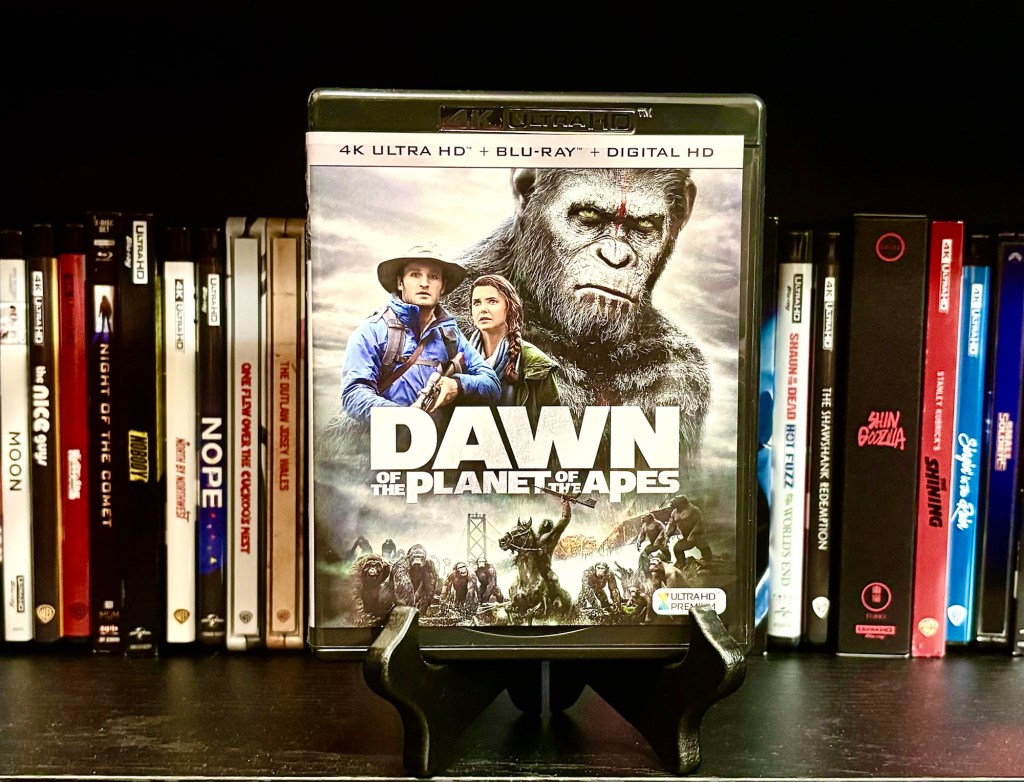
Written by Dean Zarbaugh II
The future is worth fighting for. A group of scientists in San Francisco struggle to stay alive in the aftermath of a plague that is wiping out humanity, while Caesar tries to maintain dominance over his community of intelligent apes.
Matt Reeves directs the sequel to Rise of the Planet of the Apes and brings tensions to a head. There are two factions in the ape tribe. Caesar’s and Koba’s. Where Caesar has seen the bad that humans are capable of, he has also seen what good they can be capable of. He seeks a more laissez-faire approach to the apes relationship with humans, Koba sees them as an existential threat to apes. This division widens when Caesar agrees to help a faction of humans restore power to San Francisco.
Meanwhile, the human race is dealing with the effects of the simian flu, which has wiped out a majority of humanity in the ten years since the events of Rise. It’s almost haunting to look back on it now after the worldwide pandemic of covid-19, and the effects it had on populations across the globe, which only heightens the story on subsequent viewings.
Matt Reeves (Cloverfield, The Batman) is one of the best directors working in the business today and Dawn is some of his best work. He is able to bring an emotional weight and depth to Caesar and his role as leader and the challenges he faces from apes like Koba who have different opinions on the humans and apes alike. Caesar’s most important teaching is that apes do not hurt apes. Humans hurt each other. Go to war with each other. Apes will be better. Reeves knows how to film action scenes and Dawn has some intense ones including the ape attack on the human’s encampment, where Koba dual wields automatic rifles while riding horseback and taking control of a tank from the humans. Cinematographer Michael Seresin and Reeves don’t shy away from the destruction and sacrifices made on both sides and the effects they have on the people and the apes respectively. The action sequences almost feel documentary in nature, taking you right up close to the action and chaos.
The script from Amanda Silver, Rick Jaffa and Mark Bomback builds on the story from the first film. Time jumps forward ten years. Apes have lived in relative peace with no contact from humans. When that all changes, it’s an all out battle between Caesar and Koba for leadership of the apes. The story explores themes that show how alike apes and humans are when you get down to it. They each love their families and want nothing more than to provide a peaceful life for them and will do whatever it takes to do so. It also deals with the idea of “found family” and how we come together in tough times. Trust is another theme that is prevalent throughout the story not just between apes and humans but between apes and apes and humans to humans as well. The story focuses on not judging people or apes as groups, but individuals and their actions.
Returning to the role of Caesar is the wonderful Andy Serkis who brings the ape to life via motion capture performance. You can see the emotional struggle he’s dealing with in his face. He gives Caesar a vulnerability that lets us sympathize with him and his cause. We’ve seen what he’s been through and how it’s taken a toll on him, and the weight of his responsibility as a leader, a husband, and a father. Through his work on the Apes films and Lord of the Rings previously, he is now one of Hollywood’s most sought after actors. He would eventually re-team with Reeves for The Batman, playing Bruce Wayne’s trusted aid and butler, Alfred Pennyworth, in a live action performance that is on par or better with his motion captured performances.
Toby Kebbell’s Koba is absolutely ruthless. He has a much more menacing appearance than Caesar due to the scarring from a much harsher life at the hands of humans than Caesar. Due to this, his views on humans are completely antithetical to Caesar’s. Caesar himself says, “From humans Koba learned hate. But nothing else.” This upbringing filled Koba with a lust for vengeance and the destruction and enslavement of the human race. Once the victim, Koba is eager to turn the tables on the human race who did nothing but experiment on him his entire life, and show them what life in a cage is like. He will stop at nothing to make this happen. Even if it means hurting other apes.
The human cast is completely different from the first film with Jason Clarke, Keri Russell, and Kodi Smit-McPhee as a family trying to stay together in tough times. They are great additions to the cast and have a wonderful chemistry together. Clarke’s Malcom is in Caesar’s shoes on the human side. He’s simply a man looking to give his son the best life possible. Russell is always on point no matter the role she plays. She plays Ellie, who finds herself struggling to get Malcom’s son to accept her. Kirk Acevedo also joins the cast as Carver, a man who does not like apes and sets things in motion that can’t be undone and have long lasting consequences for both humans and apes. You can see his motivations and why he doesn’t trust the apes, but his attitude and the way he goes about handling situations only makes things worse. Gary Oldman is a delight as he is in everything he does.
Weta Digital returns to helm the visual effects in the film which have massively improved since the last film. The performances that they are able to capture from the actors playing the apes in nothing short of extraordinary. They feel like real characters.
Dawn of the Planet of the Apes is the Empire Strikes Back of the trilogy, plunging the characters into the precipice of all-out war. It’s a wild, emotional and action-packed thrill ride from start to finish that grabs you by the collar and doesn’t let go until the end, leaving you wanting to know what happens next. Hint: it’s war. War For the Planet of the Apes.
Grade: A





 The Dean of Cinema
Leave a comment