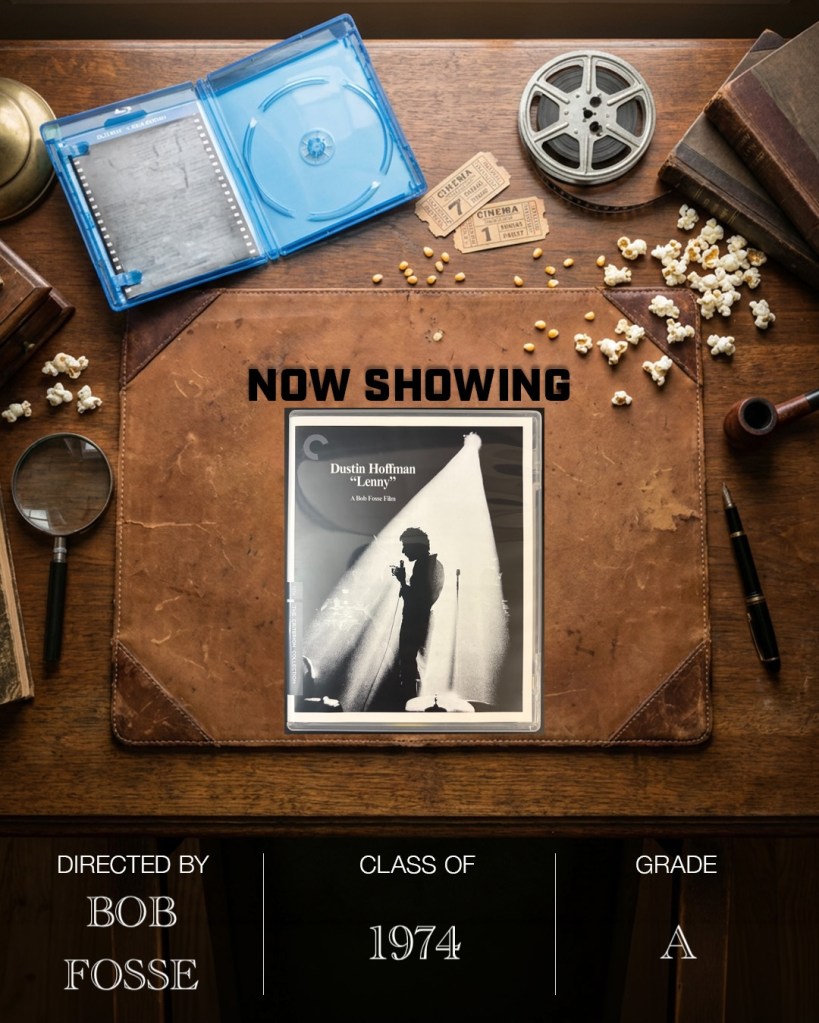
Lenny Said It. “Hot Honey” Did It. Together They Shocked America. The story of acerbic 1960s comic Lenny Bruce, whose groundbreaking, no-holds-barred style and social commentary was often deemed by the establishment as too obscene for the public.
Written by Dean Zarbaugh II
Growing up, I listened to a lot of stand up comedy albums. Robin Williams Live on Broadway was on repeat so much that I could probably still recite it from memory. Stephen Wright’s album I Have A Pony was listened to so much that I wore out the tape that my dad gave me when he introduced me to Wright’s comedy. He was one of the few who could really get dad going with laughter. Steve Martin’s Wild and Crazy Guy Comedy Is Not Pretty and Let’s Get Small were also in rotation. I loved the way these comics thought and conveyed those thoughts on stage.
After graduating from film school, I spent five years living in Los Angeles. Most of that time was spent performing standup in dive bars and comedy clubs all across the city, and sometimes even the county trying to make people laugh. Trying being the operative word there. It’s a tough racket, and it’s definitely not for the faint of heart. It’s only you up there on stage with a microphone. No safety net. It was nerve wracking, especially for someone like me who didn’t like public speaking that much.
Spending all that time in bars and comedy clubs that require a two drink minimum to get stage time, it was easy to see how one could develop a drinking habit. Don’t get me wrong, there were plenty of sober comics at all of these open mics, and were often the funniest ones, but I also knew a lot of fellow comics who struggled with hard drugs as well in order to cope with “the life,” but that was never my bag. Sure, I loved John Belushi and Chris Farley as much as the next guy, but the last thing I would want to be involved in is coke or heroin. Lenny Bruce, on the other hand…
For those of you who don’t know Lenny Bruce, he was an icon in the comedy world. He pioneered what could be said into a microphone in public. He was a satirist, comedian, and a social critic. He went after hypocrisy, especially from those in power. He rubbed a lot of the powers that be the wrong way. Years before George Carlin would go on to perform his “seven dirty words” routine, Lenny Bruce was saying them into a microphone and even getting arrested for it multiple times. Carlin was even present in the club in Chicago the night Bruce was arrested for obscenity there. Unable to provide identification, Carlin was hauled off in the same vehicle as Bruce. Bruce showed Carlin what could be done from behind a microphone. You could be funny, but you could also speak truth to power. He also had a terrible childhood, and struggled terribly with heroin and methamphetamine later in life. He was a complicated person who battled a lot of demons.
Lenny is an intimate look at the life of Bruce and his rise to social icon and his eventual downfall at the hands of drugs and his own ego. It’s a brilliant film that doesn’t shy away from Bruce’s more objectionable behavior. In fact, they’re front and center throughout. The screenplay from Julian Barry bares most of the skeletons Bruce kept in his closet. His disrespectful treatment of his wife, who herself isn’t wholly innocent of her own crimes but nonetheless doesn’t deserve to be treated the way Lenny Bruce treated her. Even though the film is centered on a comedian, don’t go in expecting a barrel of laughs from Lenny. While every word Hoffman utters on stage or in a courtroom are Bruce’s own words, they don’t come off as comedy in this tale, but more of a portent of things to come for Bruce.
When one thinks of Bob Fosse movies, one thinks of Liza Minelli in All That Jazz or Cabaret. Big, boisterous, colorful, vibrant productions. Fosse strips all of that away in favor of one man standing on a stage in Lenny. He does an amazing job behind the camera. During Lenny’s performance late in the film in Chicago, the camera follows him to the stage and then never moves an inch as Fosse forces you to watch the comic with a gift for words, struggle to find them as he is drunk and drugged out of his mind. In other scenes, he gets the camera right up in Hoffman’s face, giving him no place to hide. He shot the film in stark black and white, giving it a gritty look that matched its protagonist’s stage persona. While it isn’t as vibrant as Fosse’s other work, it is every bit as entertaining.
Dustin Hoffman gives one of my favorite performances of his in Lenny. He is a tour-de-force as Lenny Bruce, commanding many scenes on his own, with a spotlight trained on him. Hoffman rises to the occasion and owns the role, effortlessly vacillating between the social icon and drug addict sides of Bruce. He doesn’t try to outright impersonate Lenny Bruce, but instead brings his own ideas to the role. He shows how insecure Bruce felt in his new position of fame, and the desperation for him to “prove” that what he does isn’t obscene. There’s a scene late in the film where Bruce begs the judge to allow him to perform his act in the courtroom so that they can hear for themselves what he does. His pleas fall on deaf ears.
Valerie Perrine plays Honey, Lenny’s wife, and mother to their daughter. Honey is a former dancer at one of the clubs that Lenny performed in during the early part of his career. Like Lenny, Honey struggled with her drug addiction among other issues. The film is told from her and Lenny’s manager’s accounts of events after his death. Perrine is incredible in the role. She gives Honey a humanity that shines through in moments where she struggles with sobriety and wanting to raise her child. The entire film hinges on her performance and retelling of events.
Overall, Lenny doesn’t shy away from Bruce’s complicated life and persona, but also tries to make excuses for them in his constant persecution of his first amendment rights. He struggled with drugs because he had an addictive personality and no one around him who could help keep him in check. Everyone around him was willing to let him continue because he was their one man profit machine. As a work of art, Lenny is phenomenal. It’s a visually striking film that captures the problematic life of a pioneer of our first amendment right to free speech. The government doesn’t have to like what we say, but they can’t silence us for saying it. Lenny Bruce paved the way for more icons like George Carlin, Richard Pryor and Howard Stern.
GRADE: A

 The Dean of Cinema
Leave a comment