
Written by Dean Zarbaugh II
In a mad world, only the mad are sane. Shakespeare’s King Lear is reimagined as a singular historical epic set in sixteenth-century Japan where an aging warlord divides his kingdom between his three sons.
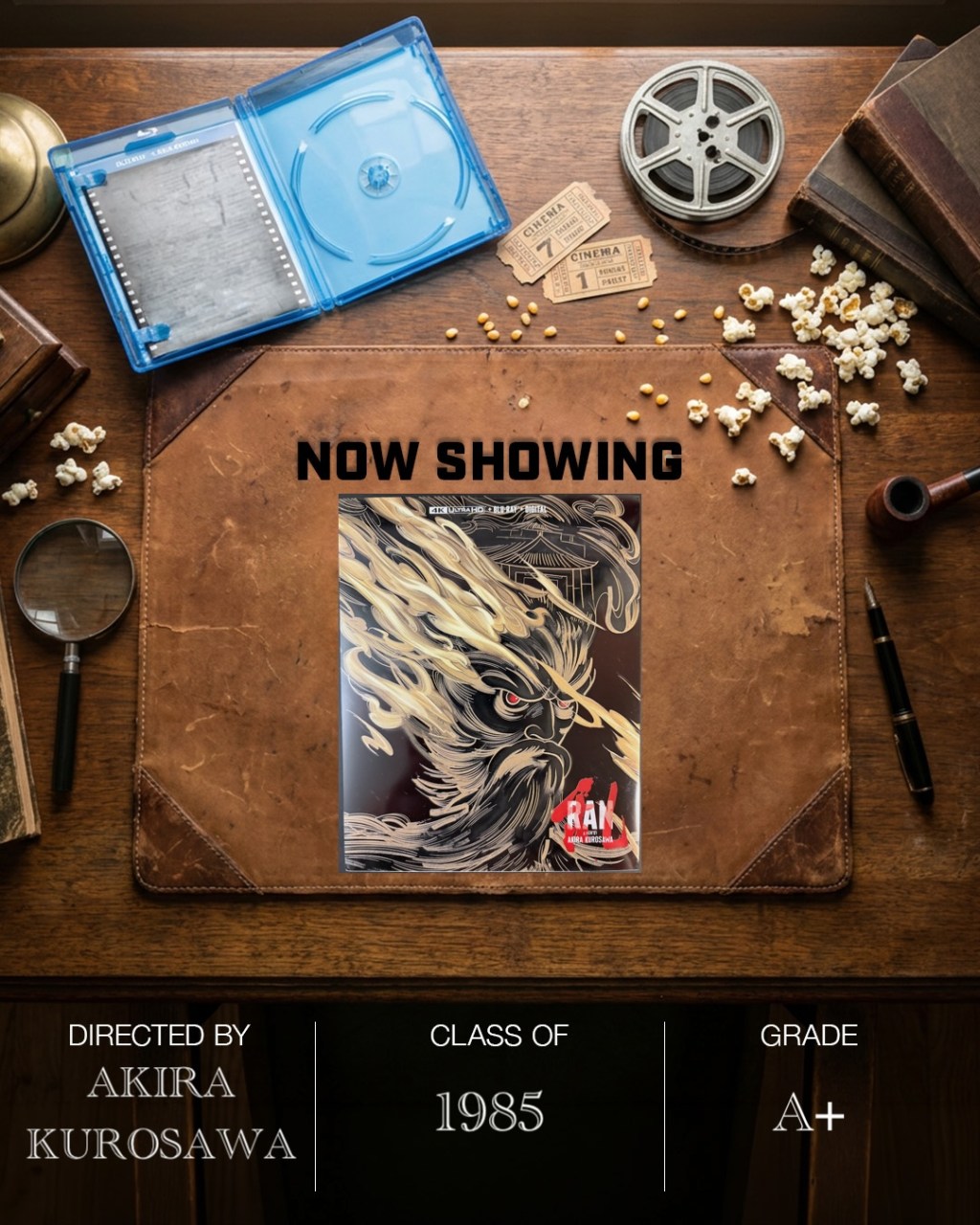
After spending the last couple of years trying to track down a US 4K steelbook release of Akira Kurosawa’s epic, Ran, fortune finally favored me for my 40th birthday. I walked into my local used media store and there it was, waiting for me. With my birthday month discount and a well-timed gift card from my nephew, I was able to grab Ran for a helluva bargain. Fuck you, eBay scalpers! Knowing my luck, The Criterion Collection will announce a 4K upgrade to their dvd edition of the film, complete with more supplemental content, of which the Best Buy exclusive steelbook is lacking. C’est la vie, I’ll buy it again. This brings my total Kurosawa collection to 11 films on blu-ray or 4K. I love watching his films and learning from them. Along with Steven Spielberg, and Werner Herzog, Kurosawa has many films in my Top 25 of all time list. He made some of the greatest movies ever made, including Seven Samurai, The Hidden Fortress, High & Low and more. His influence is felt in filmmakers from George Lucas (Star Wars) to John Lasseter (A Bug’s Life). He is, in my opinion, one of the single greatest filmmakers of all time. He was most known for his samurai films, but movies like Stray Dog, High & Low, Dreams, and more showed that he can do so much more, with equal results.
Even with how incredible of a filmmaker that Kurosawa was, it took multi-national productions to bring his later films to the screen, as he was unable to secure funding as easily from his prior resources. He found that he was considered “old fashioned” in a modern era that had seemingly moved past him. It goes to show that no matter how talented or gifted you are, a day will come where no one wants those talents anymore. It’s the circle of life. Thankfully, the French stepped in to help get Ran to the big screen.
Ran begins with Lord Hidetora Ichimonji decides to abdicate power and split his kingdom amongst his three sons; Taro, Jiro and Saburo, giving power to Taro to run things as he sees fit. Saburo, the youngest of the three isn’t happy with this arrangement and makes his thoughts known. Always one to be blunt, his disagreement with his father ends up with Saburo being banished. When his follower Tango interjects on Saburo’s behalf and affirms his feelings, Tango is also banished. This sets off a chain of events that will completely change their family and kingdom forever.
Ran is one of Kurosawa’s most beautiful looking films, on par with Dreams, Kagemusha, or Seven Samurai. An adept painter and artist in addition to filmmaker, Kurosawa knows how to use color to convey moods in his scenes. He is a talented artist, able to paint with whatever tool he is given whether it be a paint brush or a camera. Many of his shots can be framed and hung on the wall, they’re so beautiful. He is incredibly skilled at conveying depth and scope in his films, especially during battle sequences. We’ve grown accustomed to fast-paced editing of various close up shots, mixed with an occasional wide, that we’ve forgotten how great they can look by putting the camera further away and letting the action play out for the audience. The shot of the troops gathering atop the mountain while we look up at them from Jiro’s point of view of being pinned in on the battlefield. The coordination it must have taken to pull that shot off is nothing short of a miracle. It is one of the ultimate collaborations between Kurosawa and cinematographer Takao Saito. They began their partnership as director and cinematographer in 1970 on the film Dodes’ka-den, and worked together on Kagemusha, with their association culminating in the gorgeous film Dreams. Saito’s use of composition and color is utter perfection in every frame. He expertly conveys mood and ambiance with his framing and use of color in scenes. You are left constantly in awe of the beauty he is able to put on screen. It’s damn near perfection if there is such a thing. An absolute work of art in every sense of the phrase.
Kurosawa keeps you on the edge of your seat the entire film. He knows how to pace his stories, giving them room to breathe, while also not wasting a single moment. Ran marks the third adaptation of Shakespeare in Kurosawa’s career. The first, Throne of Blood is my favorite retelling of “Macbeth.” Kurosawa would go on to direct The Bad Sleep Well, which was his adaptation of “Hamlet.” Ran is my favorite retelling of “King Lear.” Kurosawa’s adaptations make for a great way to expose Shakespeare averse students his work. Even Throne of Blood in black and white is a lot more accessible to teenagers than the original texts/plays in Shakespearean iambic pentameter. While Lear explored undeserved suffering, in Ran, Ichimonji has spent decades on the warpath, destroying the lives of countless men, women and children in order to amass and maintain his power. He was merciless, sadistic, and cruel, killing entire families and gouging out people’s eyes to make his points clear.
Even at almost 3 hours long, the film breezes by, making excellent use of its runtime. It is a compelling look at power, war, betrayal, and pride and how it changes people. This is a theme that has been seen throughout time, up to and including present day, as those who are in power are afraid to lose it. It’s a study on the consequences of being in power and what it takes to hold onto it. Ran explores the inherent destructive nature of humanity. Saburo talks about the kind of world they live in which is “barren of loyalty and feeling” and urges his father to reconsider his decision regarding how he divvies up power amongst the sons. Typical of those in power, Hidetora refuses to do so and finalizes his decision. Ran highlights the animalistic nature of man throughout the film, and how we are destined to repeat the same cycle over and over again.
The cast is phenomenal. Led by Tatsuya Nakadai as Lord Hidetora Ichimonji who absolutely smashes the role. When the film begins, he exudes strength and power, striking fear in his enemies, and loyalty from his followers. However, that power diminishes as he sees what his decision has wrought on his children and his kingdom. As the film progresses, and Lord Hidetora’s condition worsens, he slips further and further into insanity and Nakadai is truly haunting in these later scenes. He conveys so much emotion with a single look. He sees the consequences of his actions laid bare in front of him and the pain that he has spread through the land. It’s one of the greatest performances put on film.
Mieko Harada is the one who steals the show as Lady Kaede, wife of Hidetora’s son Taro. She was married to Taro after Hidetora massacred her family and claimed their castle as his own. She has spent years planning her revenge and she seizes the moment no like no other. She is highly manipulative of her husband Taro as well as Taro’s brother Jiro, whom she begins a torrid affair with after the murder of her husband. She gets her hooks into Jiro, manipulating him into going against his own generals and even his wife. Harada is mesmerizing every time she is on screen. She commands every frame she’s in and exudes the power and confidence that the Lady Kaede role requires.
Daisuke Ryu plays Saburo and gives the character a lot of depth as he goes through his journey of forgiveness and reconciliation with his father. He gives a wonderfully grounded performance that balances well against the more animated performances from Nakadai and Harada. Saburo shows loyalty to his father, even after his banishment, and genuinely seeks reconciliation with him in light of his brothers’ betrayal of Hidetora.
A masterpiece of not just his later work, but his entire career, Ran is a culmination of everything Kurosawa has learned over his storied career through films like Yojimbo, Sanjuro, Seven Samurai, Throne of Blood, and unleashes it on the screen with gusto. It’s widely regarded as one of the greatest films ever made and it not only lives up to the hype, but surpasses it. A true work of art in every sense of the term, Ran is a must watch, and cements Akira Kurosawa’s legacy as the maestro of cinema.
GRADE: A+

 The Dean of Cinema
Leave a comment