Written by Dean Zarbaugh II
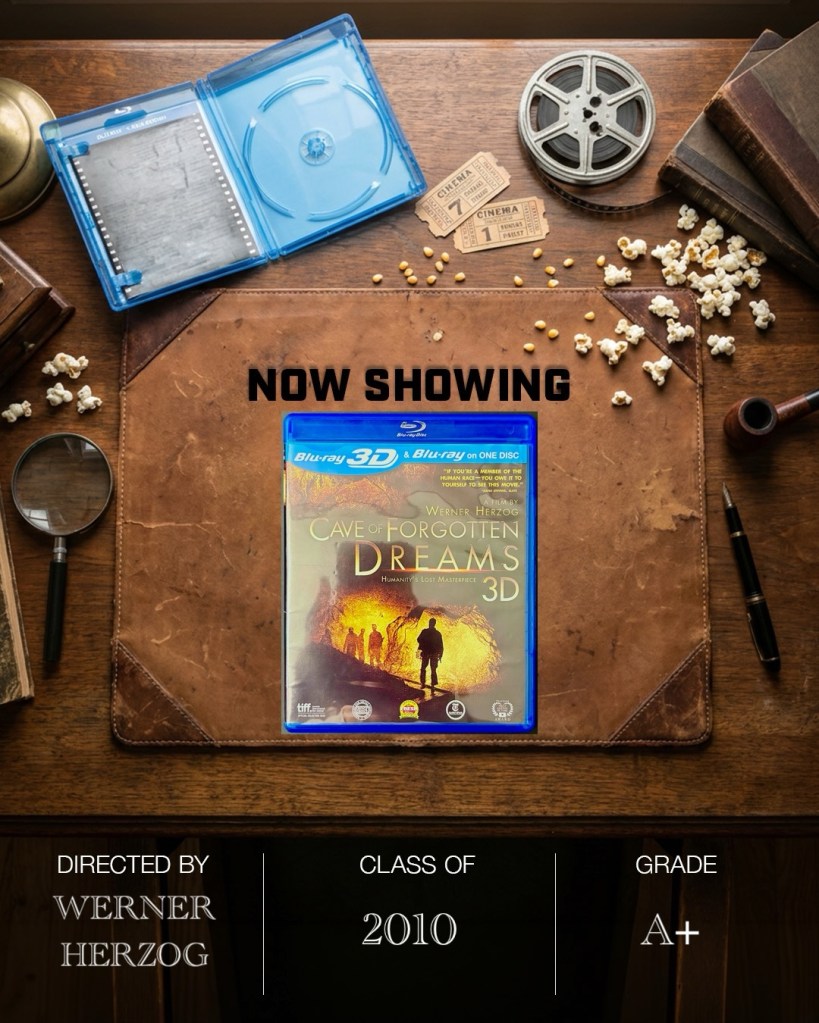
Humanity’s Lost Masterpiece… in 3D. Werner Herzog gains exclusive access to film inside the Chauvet caves of Southern France, capturing the oldest known pictorial creations of humankind in their astonishing natural setting.
Another day, another post of me talking about Werner Herzog. This time, the adventurous filmmaker takes us to the Chauvet-Pont-d’Arc Cave in France that had been sealed off from man until its discovery in December 1994. Inside this immaculately preserved cave, Eliette Brunel-Deschamps, Christian Hillaire, and Jean-Marie Chauvet discovered the earliest known paintings by our ancestors, dating back some 35,000 years.
Herzog and a crew of three, including longtime cinematographer Peter Zeitlinger, were granted limited access to the cave in order to make this documentary. They were only granted six production days inside the cave, with each day limited to only four hours. They had to wear special suits and boots that have never left the cave. Even Judith Thurman, the author of the article Herzog was inspired by was denied access to the cave. She was shocked Herzog was granted access. In true Herzog fashion though, he gives her a co-producer credit on the film for her work. He worked for only a single Euro, and gave the government his raw footage for their use in non-profit productions. Herzog clearly has a love and admiration for the history, and it’s his reverence for that history that makes him the perfect filmmaker for this odyssey.
Nothing can prepare you for seeing the paintings for the first time. Due to a rockslide at some point in history, access to this cave had been cut off, sealing the paintings inside. This level of preservation gives viewers the impression that they could have been painted yesterday. In fact, the paintings were so well preserved that their origin was originally doubted until carbon dating proved their authenticity. The amount of detail in the paintings is incredible. Some even have the illusion of movement, marking a sort of “proto-cinema” according to Herzog. The cave, and the drawings inside are nothing short of jaw-dropping. The idea that this cave has existed for thousands of years, untouched by man is astonishing. The detail in the paintings and their proximity to the likenesses of modern day animals boggles the mind. What is the meaning behind them? Are they ancient forms of storytelling? Are they observations of the world at the time? Were they a way of communication? This unknown drives not only the film, but the scientists studying the paintings.
No one is able to penetrate the human psyche quite like Werner Herzog. It is his constant exploration for education and understanding that guides his films, especially his documentaries. The guiding principle behind Cave of Forgotten Dreams is the idea that these paintings were “the first evidence of the human soul.” What does that mean? Art is the birth of human expression. It was not only how early man communicated, but it was a way to express themselves and what they’ve seen. Herzog taps into this throughout raising questions about why the paintings were made in the first place. The one lone depiction of a human form found in the French cave paintings, an exaggerated version of the Venus figurine, was almost identical to Venus figurines that were found in the caves in Germany. The statues pre-date the Venus myth, however scientists use this terminology because of their likely association with fertility and sexuality in their culture. One scientists even calls into question the use of “Homo sapiens” to describe humans as “man who know” because as Herzog loves to highlight in his films, we simply don’t know. “Why?” is what has driven humanity’s expansion from cave painting societies to the world we have today. It continues to be the groundwork for our exploration of earth, space and the great beyond. A better name for us would be “homo spiritualis,” the man spirituality. I personally love this idea because it is our individual spirituality that guides us in our endeavors.
Throughout the film we are introduced to the team of scientists tasked with preserving this historical find. One scientist, Julien Monney, a former circus worker of all things, makes the point that certain cultures like the Aboriginal tribes in Australia use art not for expressing personality, but more for the transmission of the spirit. This idea ties into a remark Herzog later makes about being alone in the cave, and he “got the feeling that I was being watched. Eyes were on me—eyes from 30,000 years back.” Not the eyes of the paintings, mind you, but the eyes of the painters. Not that he believes in ghosts, but one can’t help but be taken by the sights and feeling in the cave. What was the meaning behind these paintings and can we accurately translate it in modern language? Monney also talks about his experience after leaving the cave for the first time and how the experience inside began penetrating his dreams and subconscious with imagery of lions, both real and in painting form.
Archaeologists Gilles Tosello and Carole Fritz are tasked with taking pictures of the paintings and the walls, tracing over the images and through the use of technology, are able to sequence the murals to different time periods based on the results. First, the artists wore down the walls until the white limestone was showing, and used that as their canvas. In a way, they become collaborators with the artists, helping us understand what went into making them.
Also true to Herzog form, he introduces viewers to a couple of scientists who in the hands of any other filmmaker would come off as a joke, but with Herzog, it’s illuminating the different levels of the human psyche. Take experimental paleontologist Wulf Hein, who fashions a replica of an ivory flute found in similar cave in Germany. He uses this replica to play the tune of The Star Spangled Banner, which is as ridiculous as it sounds, but at the same time intrigues me to no end that music, like art can be passed down through centuries of tradition. We are also shown how the people who inhabited the German sites evolved similarly to those found in France.
Then there is perfume maker Maurice Maurin who explores the region hunting for more hidden caves… with his sense of smell. It almost seems laughable watching him go around and sniff rocks until you listen to him talk about what he’s looking for and how close it is to how archaeologists discovered Chauvet-Pont-d’Arc Cave in the first place: by finding drafts emanating from beyond the rocks.
Today, the Chauvet-Pont-d’Arc Cave is closed from outside access. Mold from the breath of visitors began growing inside, so the decision was made that the only people allowed inside are the scientists continuing the mission of preserving and interpreting the art inside.
No one is able to instill a drive to get out and tell stories like Werner Herzog. He inspires me as a writer and filmmaker to focus on stories that appeal to me, and on substance over style. None of his movies are the flashiest, yet they motivate me more than all the style in Hollywood combined. Cave of Forgotten Dreams is a beautiful, emotional, and awe-inspiring look at the origins of the human soul represented in art form. It brings out your inner child’s sense of wonder. Who are we? Why are we here?
GRADE: A+




 The Dean of Cinema
Leave a comment