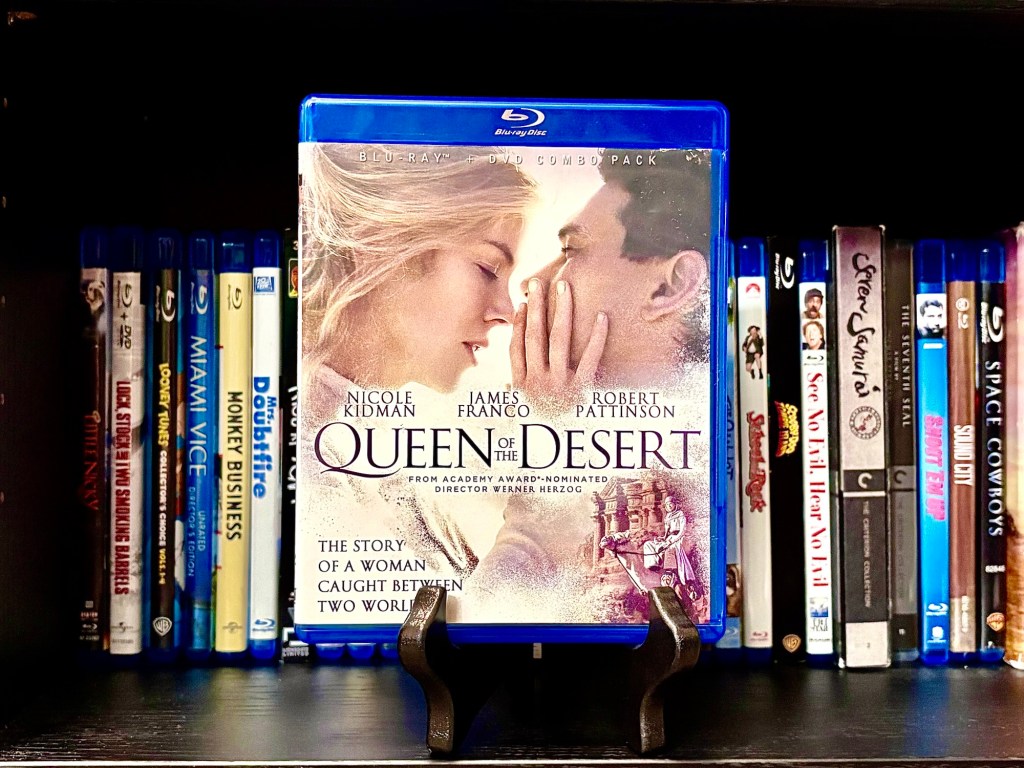
Written by Dean Zarbaugh II
One woman can change the course of history. A chronicle of Gertrude Bell’s life, a traveler, writer, archaeologist, explorer, cartographer, and political attaché for the British Empire in the Near and Middle East at the dawn of the twentieth century. Her knowledge of the tribal leaders is used by the British to establish the Kingdoms of Iraq, Jordan and Saudi Arabia.
Written and directed by the illustrious Werner Herzog, Queen of the Desert recounts the travels and education of Gertrude Bell, an English archaeologist, explorer and writer who played an important role in delineating the borders of what would become modern day Iraq and Jordan. I’ve written about Herzog and his films before and how much his work like Aguirre, The Wrath of God, Fitzcarraldo, and Stroszek, has inspired me as a filmmaker, but it was awfully fun watching one of his films that flew under my radar like this. Queen of the Desert marks the 32nd Werner Herzog film in my physical media collection, the most of any director by a wide margin. His filmography is massive, having directed over 80 films throughout his career. His output is simply unmatched. He has filmed all over the world, and has told some of the most intriguing stories of the last nearly 60 years. He’s a master at bringing the audience into the life of his characters and taking them along for the ride.
True to form for a Herzog film, Queen of the Desert focuses on a strong, sometimes brash, and always blunt protagonist charting their way in the world. Where previous Herzog films mainly focused on a male protagonist, he turns the formula on its head and centers the story on one of the most powerful women of her time. With the flipped formula in place, Queen of the Desert treats the men in the story as objects for Bell to pine after. She is the perfect center point for a story crafted by Werner Herzog. He excels at bringing us into the story and making us cheer for Bell on her quest to learn as much as humanly possible about the Middle East, and free the Arab states from Ottoman oppression.
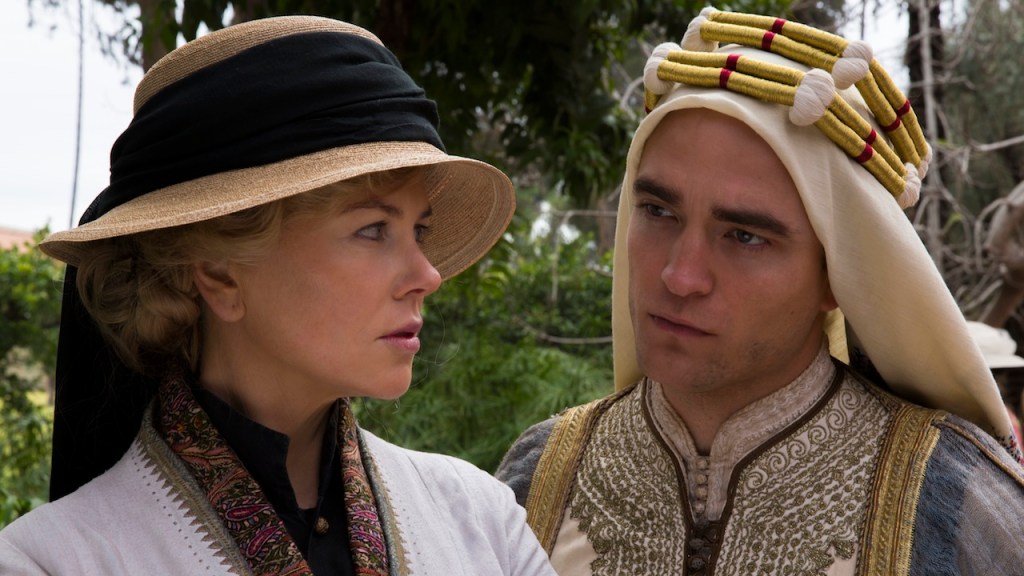
Having seen Lawrence of Arabia, and read about T.E. Lawrence’s adventures in the Middle East, I was shocked to find that I knew next to nothing about the equally, if not more important woman involved in establishing the present day Kingdoms of Iraq and Jordan. Queen of the Desert makes for a great double feature following Lawrence of Arabia. Gertrude Bell is a highly educated woman who is not one to wait for anyone. She is not a woman to be summoned or dismissed. Her only quest is for knowledge and adventure, and won’t let anyone, especially a man, stand in her way. She was incredibly intelligent, having been fluent in six languages; Arabic, Persian (Farsi), French, German, Italian and Turkish. She doesn’t do anyone’s bidding, choosing to work only for herself and the betterment of the people seeking a better life. She sets out to forge her own destiny, and along the way, she ends up in Persia where she meets and falls in love with Henry Cadogan, who helps her learn to translate Farsi into English, fanning the flames of Gertrude’s passion for the region and her love of poetry. However, her father forbids their marriage due to Cadogan’s past. She later meets Lieutenant Charles Doughty-Wylie, who is married, but longs for Bell. These relationships are important not because she needed a man in her life, but for the push that they provided for her to continue her explorations. Not for them, not for the government, but for herself.
Bell pushes herself beyond the boundaries of her upperclass world. She longed for more than being arm candy for some rich tycoon or politician. She yearned for a life of exploration, adventure, and education. In an era when women were sadly expected to be subservient to the male, Gertrude Bell stood out, unwilling to back down in the face of adversity, whether from her father or anyone else who told her she couldn’t do something. She sets out to prove them all wrong. It’s these qualities that make her the perfect center point for a story crafted by Werner Herzog. Like Herzog’s male protagonists, Bell is ambitious, fearless, and unrelenting, and like her male counterparts, she is an absolute delight to watch on her journey of discovery. Like the titulars Aguirre, or Fitzcarraldo, Herzog deftly captures Gertrude Bell’s resolve and willpower on her odyssey into the annals of history. Herzog knows what makes characters like Bell tick, and how to bring out their complexity on screen.
While set in the same time period as Lawrence of Arabia, Queen of the Desert is a much shorter film that uses its reduced time wisely, strictly focusing on Bell and her self-determined voyage through the blustery dunes of the Middle East in search of a deeper understanding of the people who reside there, and their conflicts with one another.
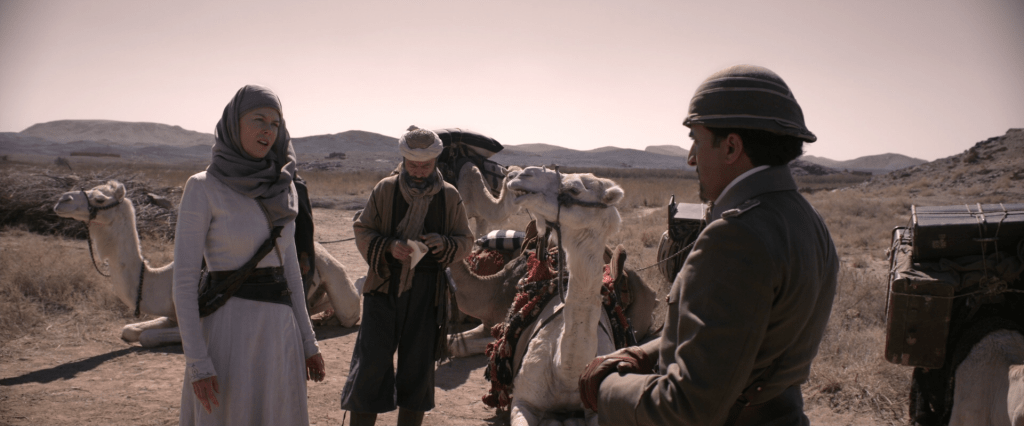
The film is visually stunning. Frequent Herzog collaborator, Peter Zeitlinger lenses this film and the way he paints with light is nothing short of magical. He brings the desert oasis to life with vibrant colors and impeccable lighting. Zeitlinger has worked with Herzog on films like Rescue Dawn, My Son, My Son, What Have Ye Done, Invincible, among many, many more. It’s clear that they have an excellent shorthand with each other and are in lockstep on how to bring the scene to life. Unlike much of his previous work which utilizes a raw, frenetic, often in your face visual style, Queen of the Desert mimics its protagonist with more elegant and refined aesthetic. It’s a testament to Zeitlinger’s and Herzog’s versatility as filmmakers. Herzog purposely places Bell in every scene to highlight her appeal to the people she met along the way.
Nicole Kidman gives a remarkable performance as Gertrude Bell. I have long admired her as an actor, especially films like Moulin Rouge and Eyes Wide Shut. What makes her stand out among other actors is the little things she does when in the background of scenes, like continuing to react to what’s going on in the foreground. A lot of lesser actors would simply stand around stiff as a board when the camera isn’t focused on them, but Kidman continues to fully respond in character. She exudes the confidence and authority of Gertrude Bell to the point that you can’t take your eyes off her. It’s clear why Herzog chose Kidman to build his film around, and I would like to see them collaborate again in the future.
Robert Pattinson’s T.E. Lawrence is a pitch perfect Peter O‘Toole. I’m amazed at how close Pattinson got to one of O’Toole’s greatest performances. I’ve said it before and I’m not afraid to admit it, but it took a while for Pattinson to grow on me because I ignorantly saw him as the Twilight vampire dude. I was completely wrong about the guy. He has some serious acting chops about him and continues to turn in dynamic performances in films like The Lighthouse, The Drama, and more. I’m particularly fond of his portrayal of Batman, but that’s not the point. His ability to channel Peter O’Toole is extraordinary. It feels like we’re getting glimpses of what Lawrence was up to when not directly helping take down the Ottoman Empire.
Damien Lewis plays Lieutenant Charles Doughty-Wylie, another man infatuated with Bell and her determination. Stuck in a loveless marriage, he yearns for Bell who refuses to commit adultery. Lewis is a tremendous actor that I became familiar with thanks to his critically acclaimed performance in Band of Brothers. He brings that same level of acting to his role in Queen of the Desert, turning in a layered performance as Wylie. Strong and bold when on the battlefield, becoming softer and more emotional when around Bell.
Overall, Queen of the Desert is a must watch for any fan of Werner Herzog, and makes for a great entry point into his oeuvre for the uninitiated. It doesn’t reach quite the same heights as his work in Aguirre, The Wrath of God or Fitzcarraldo, but it’s a much more palatable film than either of them for beginners to Herzog’s work. If you enjoy watching beautiful looking films about incredibly passionate people who push the boundaries of their world, you will like Queen of the Desert Werner Herzog’s films as a whole.
Grade: B



 The Dean of Cinema
Leave a comment